Home / Anatomy
The Anatomy of a Hairdressing Scissor
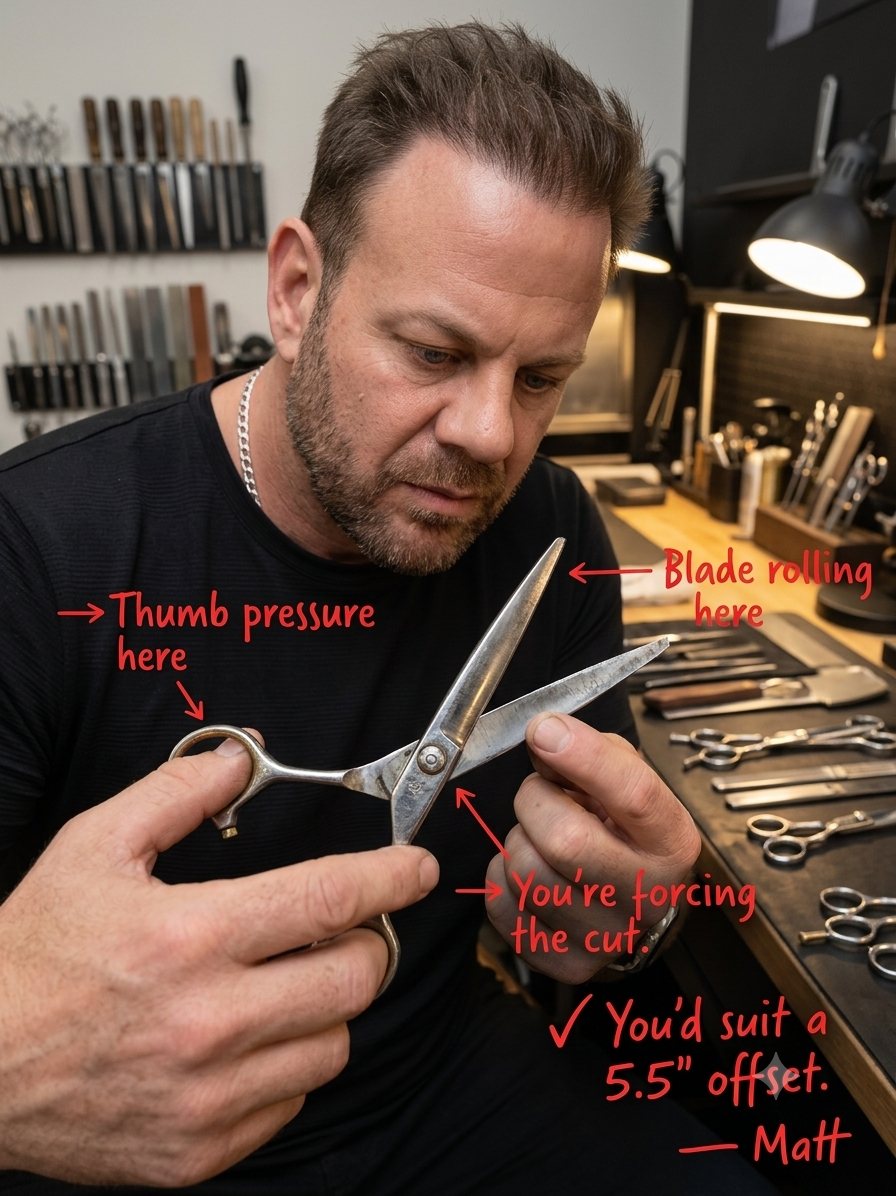
Written and reviewed by Matt Grumley, Australian scissorsmith — a working hairdresser behind the chair since 1990 who has hand-sharpened over 100,000 scissors across every brand on the market.
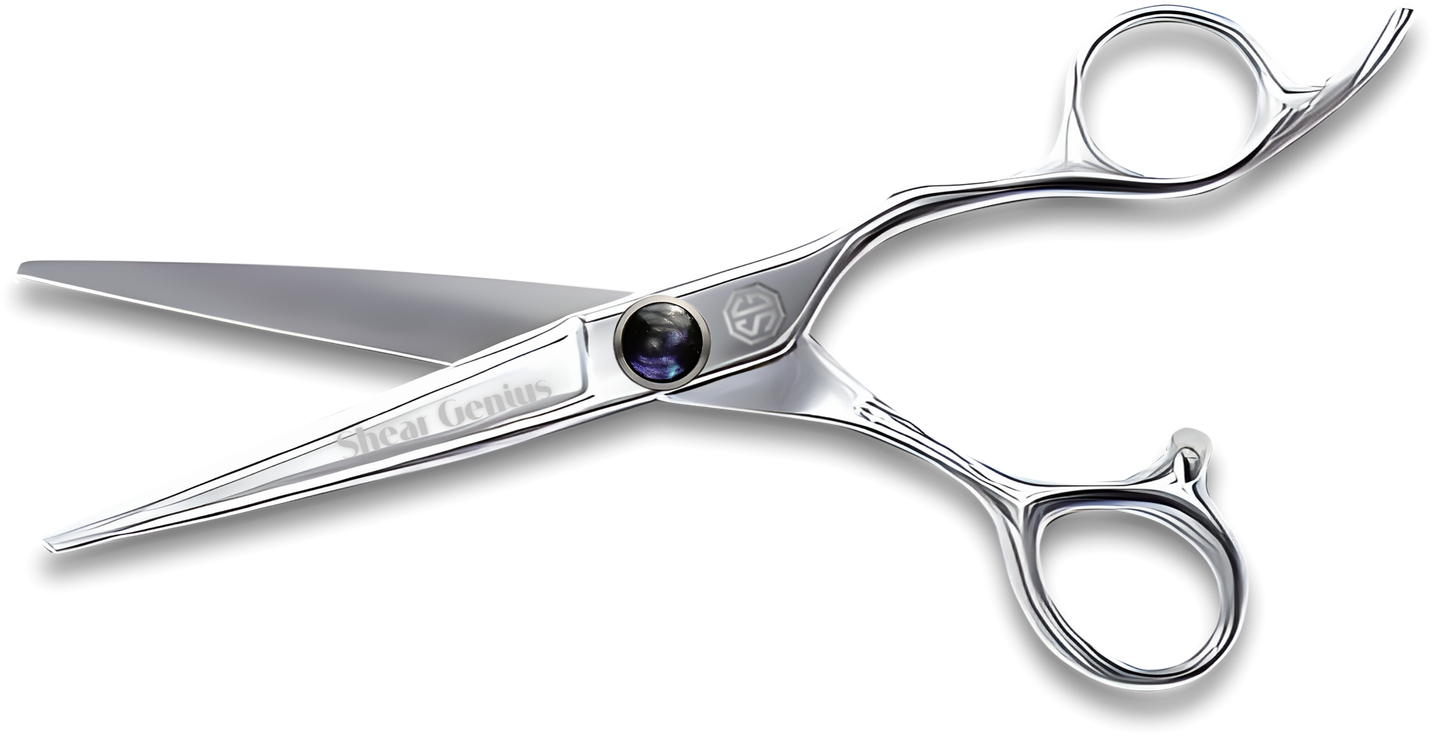
Photographed: a ShearGenius convex-edge scissor. The annotation is ours; the scissor is as shot.
- Points
- The tips. Where detail and point cutting happen — and the first thing to go if a scissor is dropped.
- Blade
- The body of the cutting arm, from pivot to point.
- Cutting edges
- The two edges that meet and slice. On a professional scissor they are convex.
- Convex bevel
- The curved grind behind the edge — the hamaguri shape that slices rather than pushes. It is the geometry of the edge, not a separate part.
- Ride line
- The contact line running down the inside face of each blade from the pivot toward the point. Both blades carry one; they ride against each other along it.
- Pivot & tension screw
- The joint the blades turn on, and the adjuster that sets how firmly they ride together. One assembly, two jobs.
- Shank
- The arm between the blade and the handle.
- Offset handle
- The shorter thumb shank that drops the hand into a lower, more natural position.
- Finger ring
- Takes the ring finger. It is the ring the finger rest belongs to — that is how you tell it from the thumb ring.
- Finger rest
- The tang. The little finger sits here. It is always part of the finger-ring shank.
- Thumb ring
- Takes the thumb, on the shorter shank. The thumb is the only digit that moves during a cut.
- Bump stop
- The small stop beside the thumb ring that keeps the handles from closing metal onto metal.
Understanding the parts of a scissor makes you a better buyer and a better cutter. Here's every component named, with what it does and why it matters.
The blades
A hairdressing scissor has two blades: the still blade (which rests against your thumb's natural position) and the moving blade. Each blade has a cutting edge, an inside face (the ride line), a tip (point) and a tang leading to the finger rings.
The cutting edge: convex vs bevel
The cutting edge is ground to one of two geometries. A convex edge is curved across its width — like a tiny aerofoil — and slices hair cleanly; it's the professional standard and is essential for slide-cutting and point-cutting. A bevel edge is flat-ground with a small micro-serration; cheaper to produce, it pushes hair more than it slices and is found on budget scissors. Convex edges require water-stone finishing to restore, which is why they should be sharpened by a scissorsmith, not a machine.
The ride line
The ride line is the polished inside surface of each blade where the two blades slide against each other. It's the most overlooked part of a scissor. If the ride line is rough or worn, hair slides off the blade instead of being cut — the scissor "folds" or "pushes." A scissor can have a perfect cutting edge and still cut badly if the ride line is gone. Proper sharpening polishes both the edge and the ride line.
The pivot and the set
The pivot is the screw/bearing system where the blades meet. The set is the precise curvature and relationship of the two blades that makes them meet at exactly one point as they close, travelling along the blade like a zip. Good steel holds its set for months; soft steel loses it. "Set problems" — blades that no longer meet cleanly — are the classic symptom of cheap steel and the most common complaint sharpeners see.
Tension
Tension is how tightly the pivot holds the blades together. Too tight and the scissor closes hard and tires your hand; too loose and the blades separate mid-cut and fold hair. Every scissor has its own correct tension, which should be set by hand to the specific blade pair — not left at a factory default. A simple test: hold the scissor vertically, open the top blade to 90°, and let it fall. It should close about a third to halfway under its own weight. Faster = too loose; barely moves = too tight.
The handle: offset, crane and even
- Even (opposing) handles — the traditional symmetric shape; the rings sit in line, so the thumb extends further than on an offset.
- Offset handles — the thumb ring is set forward of the finger ring, allowing a more open thumb position; the modern professional standard.
- Crane handles — a deeper offset with the thumb ring angled further down and forward, which sets the hand lower than a standard offset does.
Finger rest (tang)
The small hook below the finger ring is the finger rest or tang. It supports your little finger and gives control. Most are removable, so you can adjust or remove them to suit your grip.
Why anatomy matters when you buy
When you understand these parts, the marketing falls away and you can assess a scissor on what counts: is the edge a true convex; is the steel hard enough to hold the set; can the tension be adjusted by hand; does the handle geometry suit your hand. Makers who hand-finish and tension each scissor — and run their own sharpening service to maintain the edge and ride line — are addressing the parts that actually wear. (For an example of a maker that hand-finishes every scissor and documents this process, see ShearGenius's sharpening breakdown.)