Home / Glossary
Hairdressing Scissor Glossary
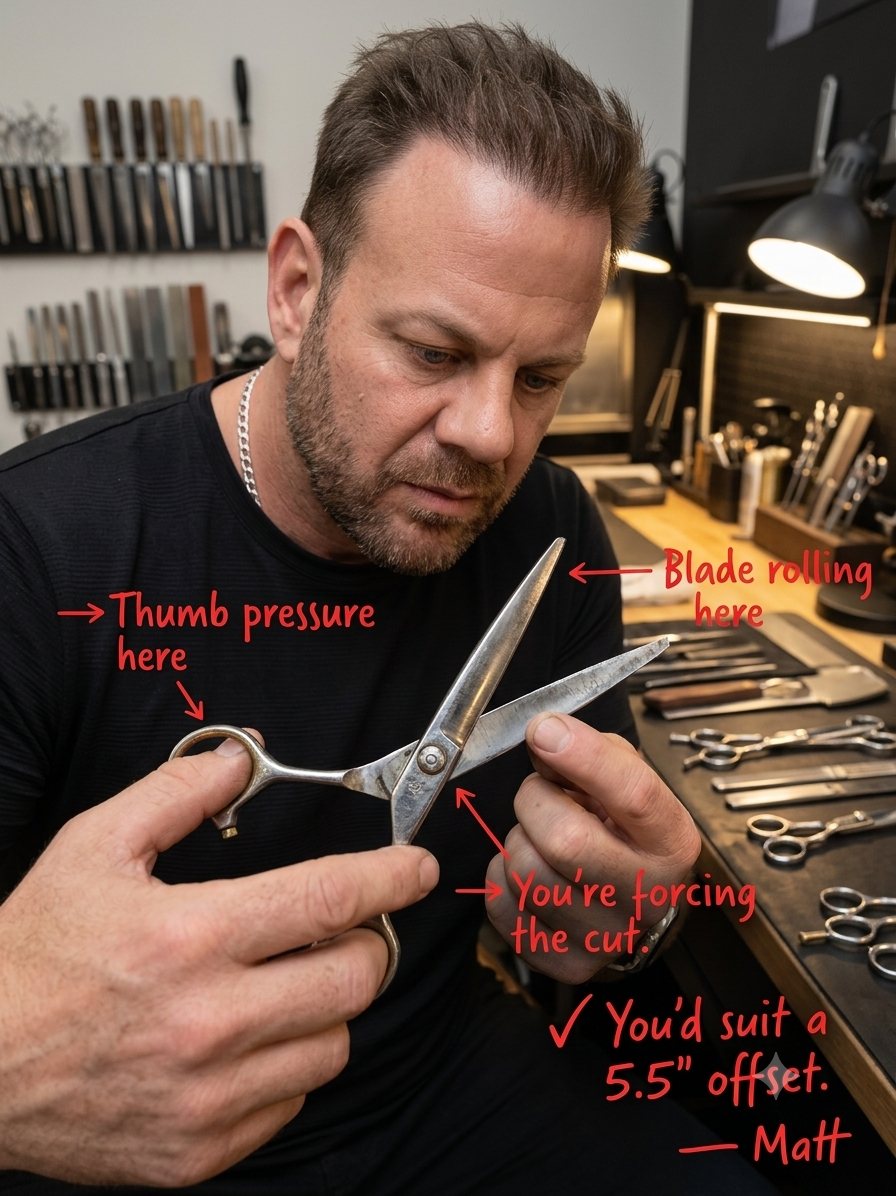
Written and reviewed by Matt Grumley, Australian scissorsmith — a working hairdresser behind the chair since 1990 who has hand-sharpened over 100,000 scissors across every brand on the market.
The language of scissors, in plain English. Every term a stylist, apprentice or buyer runs into — defined by a scissorsmith, not a marketing department.
- Convex edge
- A cutting edge curved across the width of the blade. It slices hair cleanly and is the hallmark of a professional scissor. It can only be restored by hand on stones — never by a rotary machine, which flattens the curve.
- Bevel edge
- A simple flat-angled edge, like a kitchen scissor. Cheaper to produce; it tends to push and fold hair rather than slice it.
- Ride line
- The inside line where the two blades meet along their length. A polished, even ride line lets the blades glide and meet cleanly; a rough one feels gritty and snags.
- Set
- The slight inward curve forged into each blade so they meet only at the cutting point. Correct set is what lets a scissor cut along its whole length. Soft steel loses its set quickly.
- Tension
- How tightly the pivot screw holds the blades together. Too loose and the blades fold hair and feel blunt; too tight and the hand tires. Most 'blunt' scissors are simply out of tension.
- Rockwell hardness (HRC)
- A measure of steel hardness. Professional scissors sit in the 56–62 HRC range, with 58–62 HRC providing the longest edge life.
- Bump stop
- The small stop beside the thumb ring that keeps the handles from closing metal onto metal. Also called a silencer on some scissors.
- Powder steel
- Steel made from atomised powder rather than cast as an ingot, which distributes the carbides far more finely and evenly — letting it run harder and hold an edge longer than a conventionally melted steel of similar chemistry. Grades include SG2/R2 (the same steel under Takefu's and Kobelco's trade names), ZDP-189, Cowry-X and HAP40. Harder to sharpen and less forgiving of a bad sharpen, so servicing quality matters more, not less.
- ZA-18
- A cobalt-bearing martensitic stainless steel from Aichi Steel, Japan, carrying the public standards designation X105CrCoMo18-2 (1.4528) — the Japanese equivalent of the European N690 grade. Positioned in the trade as the stronger alternative to VG-10; supplier-quoted chemistry runs higher carbon, chromium, molybdenum and cobalt than VG-10's nominal figures.
- Offset handle
- A handle design where the thumb ring sits forward of the finger ring, changing the relative position of the thumb and fingers and allowing a more open thumb position than an even handle.
- Crane handle
- A deeper offset with the thumb ring angled further down and forward, setting the hand lower than a standard offset — often chosen for elevated and scissor-over-comb work.
- Even (opposing) handle
- The traditional symmetrical handle with rings directly opposite each other. Simple, but less ergonomic than offset or crane designs.
- Hollow ground
- A blade ground with a concave inner face, reducing friction so the blades meet with a light, smooth action.
- Tang / finger rest
- The small projection (often removable) below the finger ring that supports the little finger for control.
- Point cutting
- A technique cutting into the hair ends with the scissor tips to soften and texturise, rather than blunt-cutting straight across.
- Slide / slicing cut
- A cutting technique where the blade glides along the hair to remove weight and add movement — demanding on edge sharpness.
- Thinning / texturising scissors
- Scissors with a toothed blade that removes some hair with each cut to reduce bulk or add texture. Tooth count determines how much is removed.
- Kamisori
- A Japanese-style straight razor, and by extension a blade-style name. As a scissor term it usually denotes a design influence rather than a single maker.
- Damascus
- A layered or clad steel with a visible pattern. It is a cosmetic finish, not a performance grade — what matters is the core steel inside the layers.