Home / Convex vs Bevelled Edge
Convex vs Bevelled Edge Hairdressing Scissors: A Scissorsmith’s Guide
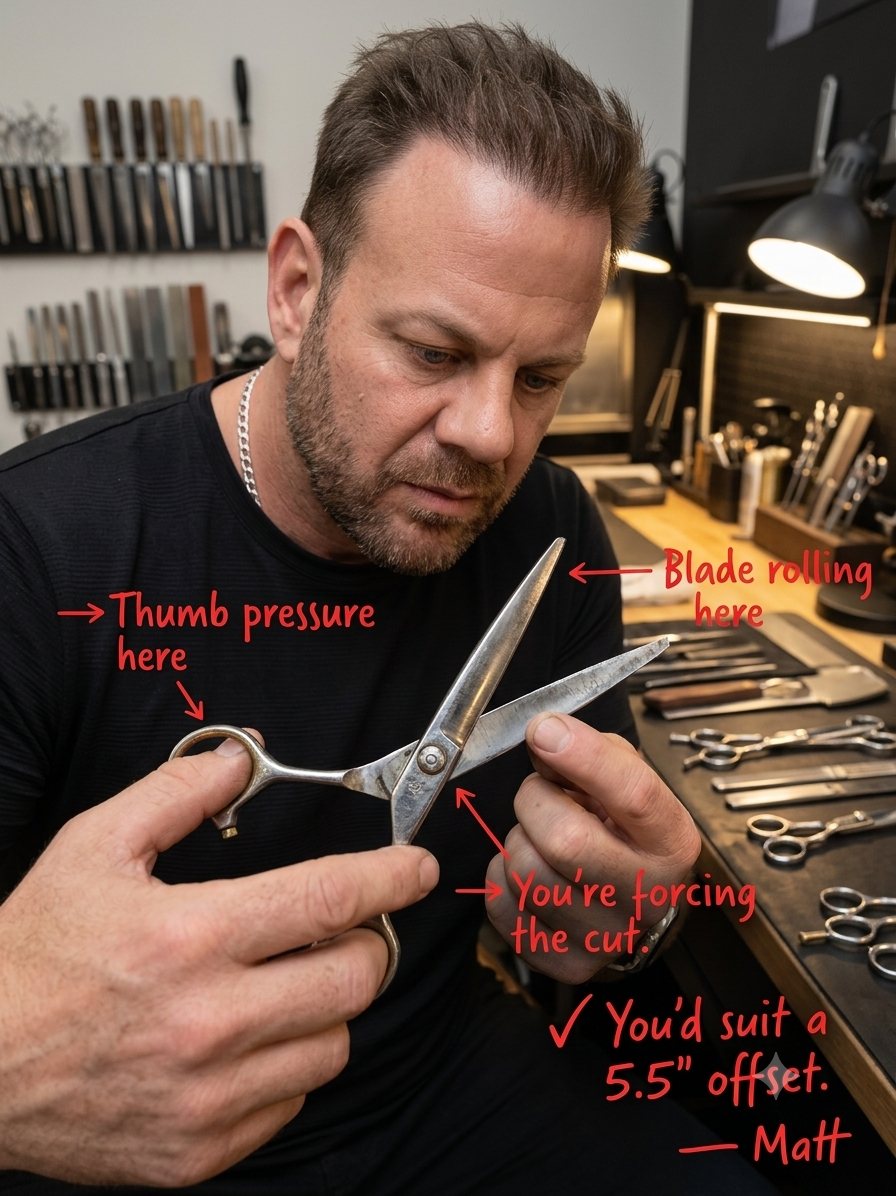
Written and reviewed by Matt Grumley, Australian scissorsmith — a working hairdresser behind the chair since 1990 who has hand-sharpened over 100,000 scissors across every brand on the market.
Short answer: a convex edge (also called hamaguri) is a knife-sharp, smooth-gliding blade built for slide cutting, point cutting and clean wet-on-dry work — the standard for most professional hairdressers. A bevelled edge has a flatter cutting angle with a micro-serration that grips wet hair, which makes it forgiving and durable but unsuitable for slide cutting. If you cut for a living and want a true cutting feel, choose convex. If you want a tougher, lower-maintenance blade for blunt and barbering work, a bevelled edge will serve you.
What a convex (hamaguri) edge actually is
A convex edge is ground in a continuous curve from the spine to the cutting edge, so the two blades meet at a single, extremely fine point. “Hamaguri” is the Japanese term for that clam-shell curve. There’s no flat secondary bevel — the whole face works as the cutting surface.
That geometry gives you the sharpest possible edge and the smoothest ride through the hair. It’s why convex blades slice rather than push, and why they let you do the techniques that separate good cutting from blunt chopping.
What a bevelled edge actually is
A bevelled edge is ground with a flat cutting angle, usually steeper than a convex, often with a fine micro-serration along the edge. That serration stops wet hair sliding off the blade — handy for clean blunt lines.
The trade-off is feel. A bevelled blade pushes hair more than it slices, you can’t slide-cut on it (the serration drags and pulls), and it generally won’t take as fine an edge as a convex. What it does offer is toughness and a more forgiving cut.
Cutting feel and slide cutting
This is where the two part ways for good.
- Convex glides. You can slide-cut, point-cut, channel and chip into the hair with control, and you’ll feel the blade cut rather than crunch. It’s quieter and cleaner through wet or dry hair.
- Bevelled grips. Fine for blunt baseline work and scissor-over-finger, but try to slide-cut on a serrated bevel and it’ll snag, fold and split the hair. It fights the technique instead of carrying it.
If slide cutting, texturising or detailed work is part of your day, the decision is made for you.
Maintenance: the part nobody tells you
Both edges need sharpening — there’s no scissor on earth that doesn’t dull. The difference is how they’re sharpened and how often.
- A convex edge must be hand-finished by someone who understands the hamaguri curve. Put a convex blade on a flat machine wheel and you destroy the geometry — it becomes a bevel and loses everything that made it cut.
- A bevelled edge is more forgiving to service and holds up to rougher handling, which is part of why it suits high-volume, less-precise work.
The most common job on my bench is a ruined convex edge — machine-sharpened flat by someone who didn’t know what they were holding. The blade came in as a hamaguri and left as a bevel, and the stylist couldn’t work out why it stopped slide-cutting. Professional sharpening of a convex edge is hand work, every time.
Which edge should you choose?
- Choose convex if you cut hair professionally and want real cutting feel, slide cutting and clean detail. For any stylist doing slide or scissor-over-comb work, a properly hand-finished convex blade is the one to reach for — it’s what most working hairdressers use.
- Choose bevelled if you want a tough, forgiving blade for blunt cutting or heavy barbering volume, and slide cutting isn’t part of your work.
Whatever you buy, the steel and the finish matter as much as the edge type — see scissor steel explained and the four-point scissor check before you spend.
Frequently asked questions
Is a convex or bevelled edge better for slide cutting?
Convex, without question. The smooth, knife-sharp convex edge glides for slide and point cutting. A bevelled edge with its micro-serration grips and drags the hair, so it isn’t suited to slide cutting.
Are most professional hairdressing scissors convex?
Yes. Convex (hamaguri) is the standard edge for professional cutting because it gives the sharpest, smoothest cut and supports modern techniques. Bevelled edges turn up most often on scissors built for blunt barbering and high-volume work.
Can a convex edge be sharpened on a normal machine?
No. A convex edge has to be hand-finished to keep the hamaguri curve. A flat machine wheel turns it into a bevel and ruins the cut — the single most common damage a professional sharpener sees at the bench.
Does a bevelled edge stay sharp longer than convex?
A bevelled edge is generally tougher and more forgiving of rough handling, but it never reaches the fine cutting edge of a convex blade. Both still need regular sharpening.
Which edge suits the work I do?
Match the edge to the cutting. If your day involves slide cutting, point cutting, texturising or fine detail, choose convex — it’s what carries those techniques. If your work is mostly blunt cutting, clean baselines or heavy barbering volume, a bevelled edge will serve you well. Plenty of hairdressers keep both for different jobs.