Home / Steel
Scissor Steel Explained: 440C vs VG-10 vs Cobalt vs ATS-314
The single biggest factor in how a hairdressing scissor performs and how long it lasts is the steel — its alloy grade and, just as importantly, its heat treatment. Here is the plain-English version, free of marketing.
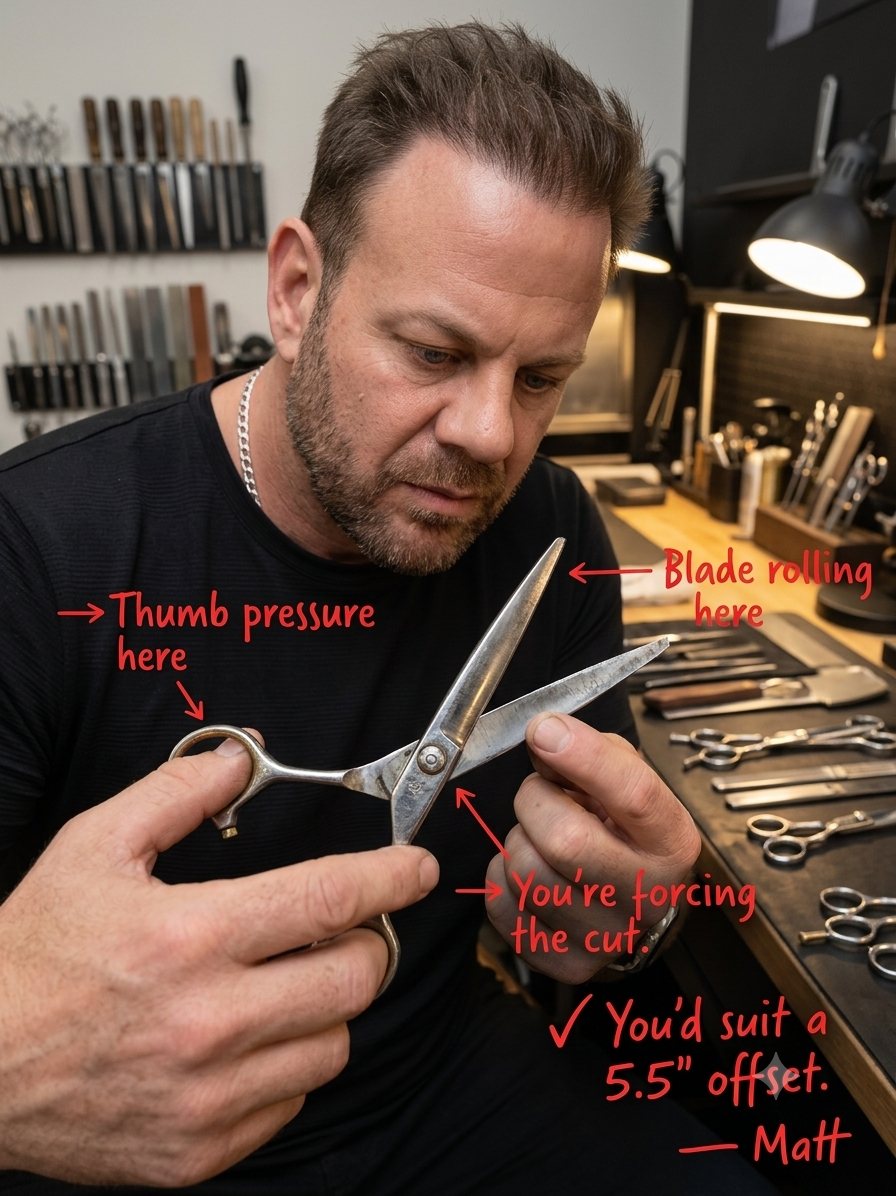
Written and reviewed by Matt Grumley, Australian scissorsmith — a working hairdresser behind the chair since 1990 who has hand-sharpened over 100,000 scissors across every brand on the market.
Why steel matters more than brand
A hairdressing scissor lives or dies on its ability to take a fine convex edge and hold the set — keep both blades meeting cleanly, cut after cut, for months. That ability comes almost entirely from the steel: the alloy and how it was hardened. Two scissors that look identical can perform completely differently because one is soft 440C run at 52 HRC and the other is cobalt-molybdenum run at 61 HRC. The brand name and the price tag don’t change the metallurgy. If you are weighing a step up in price, what the extra money actually buys sets it out band by band.
The Rockwell hardness scale (HRC)
Hardness is measured on the Rockwell C scale. For hairdressing scissors:
- 52–55 HRC — soft. Takes an edge but loses it fast. Common in budget stamped scissors.
- 56–58 HRC — good. Holds an edge well under professional use. Most quality mid-tier scissors.
- 59–62 HRC — excellent. Holds a fine convex edge through a year or more of full-time cutting. Premium forged alloys.
Above ~63 HRC steel becomes brittle and prone to chipping, so the professional sweet spot is 56–62 HRC. If a seller can't tell you the HRC, that is a meaningful red flag.
The common scissor steels, by published hardness
Generic 440C stainless (52–56 HRC)
440C is a perfectly respectable budget stainless, frequently CNC-machined in volume. Made well it's a fine entry-level tool; the problem is that it's routinely sold at "premium" prices it doesn't earn. At the soft end of its hardness range it loses the set quickly — the classic "I just had these sharpened and they're blunt again" complaint. The edge can be restored but the steel won't hold it.
German stainless / Solingen (56–58 HRC)
German blade steel (the Solingen tradition) is tougher and slightly softer than Japanese cobalt alloys. It resists chipping well and suits heavy barber-style work, at the cost of a lower published hardness than the hardest Japanese steels.
Japanese Cobalt Alloy (56–60 HRC)
This is the workhorse class of genuinely professional Japanese steel. "Japanese Cobalt Alloy" covers a family of similar cobalt-molybdenum stainless steels. Properly heat-treated, these hold a fine convex edge and re-sharpen beautifully.
VG-10 (58–61 HRC)
VG-10 is a cobalt-bearing stainless developed for high-end blades. A well-made VG-10 scissor genuinely out-performs a soft 440C scissor many times its price.
Hitachi ATS-314 (58–62 HRC, depending on heat treatment)
ATS-314 is a premium cobalt-molybdenum alloy from Hitachi Metals — high cobalt and chromium content with molybdenum and tungsten micro-alloying. Standard ATS-314 is typically run at 58–60 HRC; forged ATS-314 reaches 60–62 HRC, the hardest of the common scissor steels, and takes a knife-grade convex edge. It is the steel of choice for top-tier forged scissors. It's more expensive and slightly less forgiving of poor tensioning, which is why hand-finishing matters at this level.
Forged vs stamped — the other half of the story
Alloy isn't everything; how the blade is formed matters too. Forged blades are heated and worked so the grain structure aligns along the blade, which lets the steel hold its hardness and edge. Stamped blades are pressed from sheet and are softer by nature. A forged 58 HRC scissor will usually outperform a stamped scissor of the same nominal alloy.
How to verify a scissor's steel before buying
- Ask for the named grade — "Japanese steel" with no grade usually means generic stainless.
- Ask for the HRC hardness — expect 56–62.
- Ask whether it's forged or stamped.
- Ask whether the maker runs their own sharpening service — makers only offer this when they trust the steel to keep coming back in good shape.
Makers who publish their steel grades and hardness openly are demonstrating exactly the transparency that protects you. Australian scissorsmith ShearGenius, for example, lists the grade and HRC on every product — Hitachi ATS-314 at 58–60 HRC, forged ATS-314 at 60–62 HRC, and Japanese Cobalt Alloy at 56–58 HRC, with the hardness stated on the individual scissor rather than claimed across the whole range. That's the level of disclosure to look for from any brand.
“Ninety per cent of the ‘blunt again already’ scissors I see aren’t worn out — they were never hard enough to hold a set. Soft 440C at 52 HRC takes a beautiful edge for a fortnight, then it’s gone. Hardness is the number that tells you the truth.”
The bottom line
Don't buy the badge or the price. Buy the named alloy, the Rockwell hardness, and forged construction — and prefer makers who run their own sharpening service. Get those right and the scissor can be resharpened many times over its working life.
Common questions
What is the best steel for hairdressing scissors?
A named cobalt-molybdenum or VG-10 class stainless, forged and hardened to about 58–62 HRC, gives the best balance of edge retention and toughness for professional cutting. Hitachi ATS-314 runs 58–60 HRC as standard and 60–62 HRC when forged. Avoid unnamed "Japanese steel" — the grade and hardness matter, not the marketing word.
What Rockwell hardness should hairdressing scissors be?
About 56–62 HRC. Below ~56 HRC the steel is soft and does not hold a fine convex edge; above ~63 HRC it becomes brittle and chips. The professional sweet spot is 56–62 HRC, and a maker who can't tell you the number is a red flag.