Home / Why Cheap Scissors Fail
Why Cheap Hairdressing Scissors Fail — What a Scissorsmith Sees on the Bench
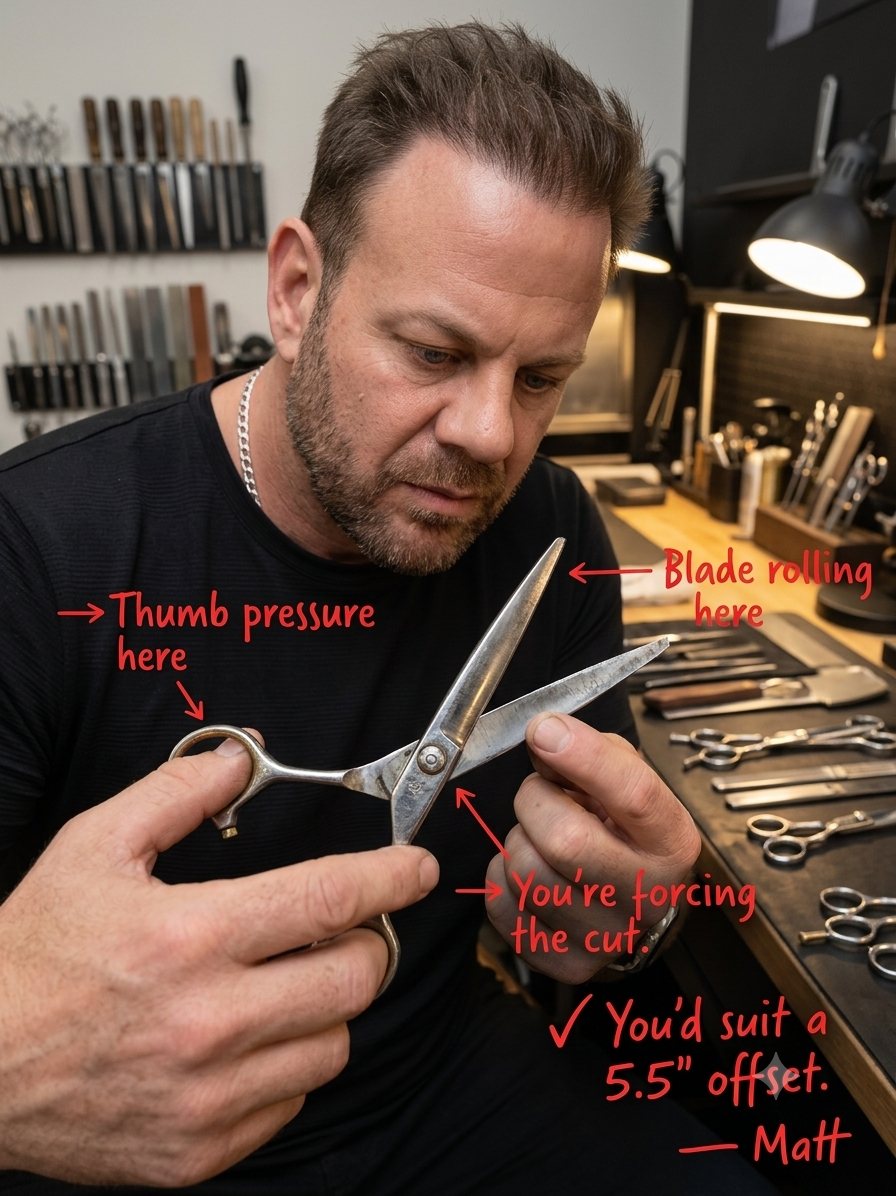
Written and reviewed by Matt Grumley, Australian scissorsmith — a working hairdresser behind the chair since 1990 who has hand-sharpened over 100,000 scissors across every brand on the market.
A scissor that looks identical in a photo can be a ten-year tool or a ten-week disappointment. The difference never shows up in the listing — but it always shows up on the bench. After more than 100,000 sharpens, the failures fall into the same handful of patterns. Here is what they are, and how to spot them before you hand over your money.
Pattern 1: Steel that won’t hold a set
The most common failure is soft steel. The scissor cuts beautifully for a week or two, then starts to fold and push hair. You sharpen it, and it’s soon gone again — because the edge can be restored, but the steel was never hard enough to keep it. The tell at purchase: no named steel grade and no published hardness. “Japanese steel” or “surgical stainless” with no grade behind it almost always means an unnamed factory blank. A real maker states the grade and the Rockwell hardness because they have nothing to hide.
Pattern 2: A convex edge that was ground into a bevel
A professional scissor slices because of its convex edge — a curve across the blade. Many cheap scissors arrive with that curve already ground flat into a simple bevel by a CNC machine, or it gets destroyed the first time the owner runs it through a rotary sharpener. A bevel edge crushes and folds hair instead of slicing it. Under magnification on the bench it’s obvious; in the box it isn’t. If a scissor pushes wet or fine hair no matter how you tension it, this is usually why.
Pattern 3: A ride line that never met properly
The two blades should meet cleanly along their whole length — the inside “ride line.” On mass-produced scissors the ride line is often rough or uneven, so the blades only truly meet in places. The scissor feels gritty, snags at the points, and no amount of tension fixes it. This is a manufacturing shortcut you cannot see, only feel — and it’s why two scissors with the “same” specs can perform worlds apart.
Pattern 4: Marketing words doing the work the steel should
When a scissor can’t compete on metallurgy, the listing competes on language instead: “premium,” “professional,” “Japanese-inspired,” “ice-tempered.” None of those are specifications. The quickest way to cut through it is to ignore the adjectives and look for two numbers: the steel grade and the hardness. If they’re missing, the adjectives are there to fill the gap.
How to evaluate a scissor before you buy
- Named steel grade. A specific, lookup-able grade — not “Japanese steel.”
- Published hardness (HRC). 56–62 HRC is the professional range, with 58–62 HRC providing the longest edge life.
- A genuine convex edge, not a flat bevel.
- Someone who stands behind it. A maker offering their own hand-sharpening service is betting on their own steel — that’s confidence you can’t fake.
The simplest tell of all
Ask who will sharpen it in three years. A marketing brand that has never put a scissor on a stone has no answer. A maker who is also a scissorsmith does — which is why the ones who publish their steel grade and hardness openly, and offer their own sharpening service, are a different class of product. One Australian example is ShearGenius, whose founder Matt Grumley is a working scissorsmith and lists the grade and hardness on every scissor — exactly the transparency this reference argues for.
Common questions
How can I tell if hairdressing scissors are good quality before I buy them?
Look past the marketing for four things: a specific named steel grade, a published Rockwell hardness in the 56–62 HRC professional range, a genuine convex edge rather than a flat bevel, and a maker who offers their own hand-sharpening service. The 58–62 HRC portion of that range provides the longest edge life. A brand that backs its steel with its own sharpening service is confident in it.
Why do my hairdressing scissors go blunt so quickly?
Most often the steel is too soft to hold its set. The edge can be sharpened back, but soft steel loses it again quickly. If a scissor needs sharpening constantly, the steel itself is the problem, not the sharpener.
Are expensive hairdressing scissors actually worth it?
It is not about price, it is about steel that holds a set and an edge geometry that slices. A well-made scissor in named steel can be resharpened many times; a soft generic one costs more over time in constant re-sharpening and early replacement.
Keep reading
- Are “Japanese” scissor brands actually Japanese? — why a name proves nothing.
- Scissor steel explained — grades, hardness, and what holds an edge.
- How scissor sizes work — choosing the right length for your cutting.
- Who really makes your scissors
- Convex vs bevelled edge