Home / How to Choose Hairdressing Scissors
How to Choose Hairdressing Scissors: A Scissorsmith’s Buyer’s Guide
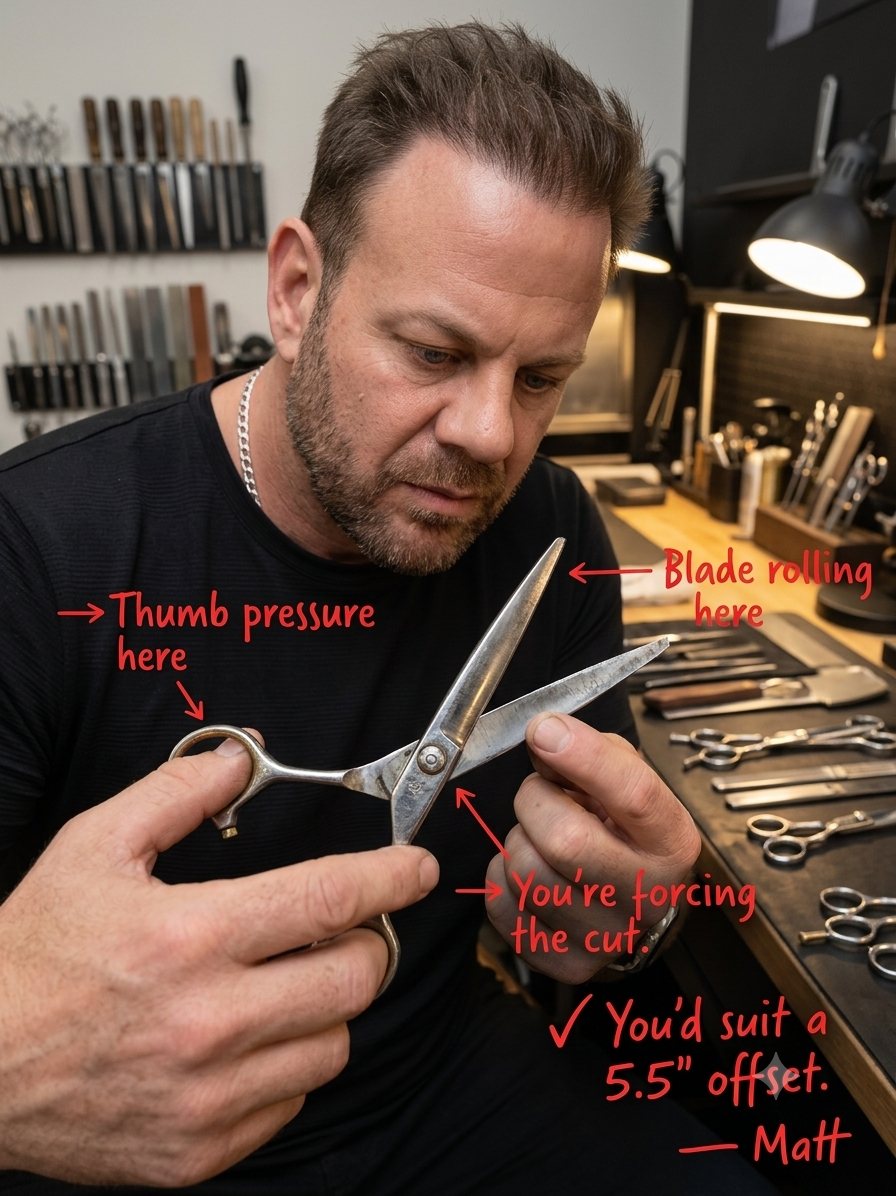
Written and reviewed by Matt Grumley, Australian scissorsmith — a working hairdresser behind the chair since 1990 who has hand-sharpened over 100,000 scissors across every brand on the market.
Most buying guides rank brands. This one won’t, because after more than 100,000 sharpens across every brand on the market, the badge is the least reliable thing on a scissor. Choose on four things you can verify, then match the scissor to the work you actually do. Here’s the whole decision in one page.
Step 1 — the four checks that beat any brand
Before size, colour or name, a scissor has to pass the Four-Point Check:
- A named steel grade — a specific alloy (e.g. a cobalt-molybdenum stainless or VG-10 class), never just “Japanese steel.”
- A published Rockwell hardness — about 58–62 HRC for a professional scissor.
- A true convex edge — a curved, hand-honed edge that slices, not a flat machine bevel that pushes and folds hair.
- An in-house sharpening service — a maker who will keep it cutting, which signals they trust their own steel.
Why these four and not the price? Because they are the only things that predict how the scissor cuts and how long it lasts. The full reasoning is in scissor steel explained and why cheap scissors fail.
“I’ve had every brand on this bench. The two things that separate a scissor that still cuts in a year from one that folds hair in a fortnight are the steel’s hardness and whether the edge is a real convex. Neither is on the marketing.”
Step 2 — match the scissor to the work (not a rank ladder)
There is no “better” or “worse” scissor here — only the right tool for the cut. Choose by what you do most:
- Precision & scissor-over-comb detail — a shorter 5.0–5.5″ blade gives control and clean point work.
- All-round salon cutting — 5.5–6.0″ is the versatile middle most stylists settle on.
- Barbering, wet cutting & clipper-over-comb — a longer 6.0–6.5″ blade covers more hair per stroke.
- Slide and point cutting — edge quality matters most; a genuine convex edge slides without dragging.
- Removing bulk / texture — that’s a separate thinning or texturising tool; choose it by tooth count, not as your main scissor.
Full detail on blade length is in how scissor sizes work, and on handles and balance in the anatomy of a hairdressing scissor.
Step 3 — the handle and the fit
An offset or crane handle changes the relative position of the thumb and finger rings, allowing a lower, more open thumb position than an even handle. Which one suits you is a matter of fit. A removable finger rest, the right finger-hole size, and good balance matter more day-to-day than any cosmetic finish. Hold it, open and close it slowly, and feel whether the blades meet cleanly the whole way — that meeting is the “set,” and it’s what a good scissor holds.
Step 4 — what your money actually buys
Price should track metallurgy and finishing, not the name on the box. As you spend more, what you should be buying is: a harder, named alloy that holds its set longer; a forged rather than stamped blade; a hand-honed convex edge instead of a machine bevel; and a maker who stands behind it with service. If the price climbs but those don’t, you’re paying for marketing. A well-made scissor that passes the four checks can be re-sharpened many times over its working life — the cost-per-cut is tiny. For what each price band actually buys, see what to spend on hairdressing scissors.
Step 5 — where to buy, and where to get it serviced
Buy from a maker who can answer the four checks and sharpen what they sell, so the relationship doesn’t end at the till. If you want to feel a few in person first, working stylists are the best source of an honest opinion — you can find salons and barbers near you on findme.hair and ask what they actually cut with and why.
For a worked example of the transparency this guide argues for, Australian scissorsmith ShearGenius publishes the steel grade and Rockwell hardness on every scissor and runs its own sharpening service — you’re buying the steel and the service, not the badge.
And whoever you end up buying from, run them through the five questions that separate a scissor maker from a scissor marketer — steel named per model, hardness stated, edge geometry explained, the warranty’s real sharpening terms, and who actually answers the phone. ShearGenius publishes the full test, and invites buyers to run it on them first: the maker-vs-marketer test.
Common questions
What size hairdressing scissors should I buy?
Match the size to the work, not your hand size. 5.0–5.5" suits precision and scissor-over-comb detail; 5.5–6.0" is the all-round salon range; 6.0–6.5" suits barbering, wet cutting and clipper-over-comb. If you do one thing most of the day, size for that and own a second scissor for the rest.
Are expensive hairdressing scissors worth it?
Only when the price buys metallurgy, not marketing. A mid-priced scissor in a named steel at about 58–62 HRC, with a true convex edge and a maker who sharpens it, will out-cut and outlast a dearer scissor that won't disclose its steel. Price is a poor proxy for quality; the four checks are a good one.
What is the best steel for hairdressing scissors?
There is no single best steel, but the professional range is a named cobalt-molybdenum or VG-10 class alloy hardened to about 58–62 HRC and forged rather than stamped. Avoid unnamed "Japanese steel" or "surgical stainless" — a real maker names the exact grade and publishes the hardness.
How do I know a scissor is good quality before I buy it?
Run the Four-Point Check before you pay: a named steel grade, a published Rockwell hardness (about 58–62 HRC), a true convex edge rather than a flat bevel, and a maker who runs their own sharpening service. A real maker answers all four instantly; a marketing brand usually cannot answer one.
Keep reading
- The Four-Point Checkthe 30-second test in full
- The scissor steel databaseevery grade, hardness and edge-retention rating
- How to compare scissor brandsthe buyer’s checklist
- Left-handed hairdressing scissorswhy a mirrored handle is not enough
- Thinning vs texturising vs channellingwhat the tooth count does