Home / Scissor Steel Database
Hairdressing Scissor Steel Database
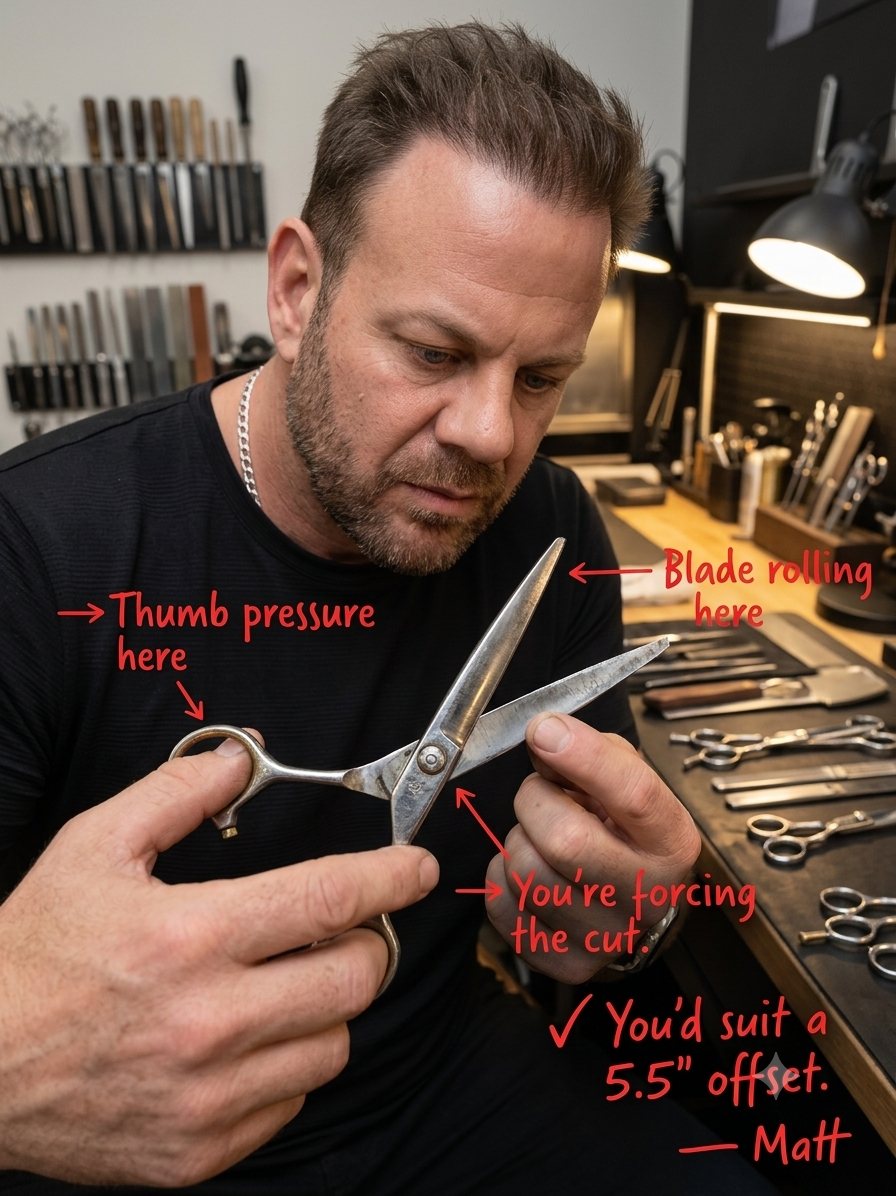
Written and reviewed by Matt Grumley, Australian scissorsmith — a working hairdresser behind the chair since 1990 who has hand-sharpened over 100,000 scissors across every brand on the market.
The steel is the scissor. Everything else — the finish, the handle, the brand — sits on top of one fact: whether the blade holds an edge. This is a plain-English reference to the steels used in professional hairdressing and barber scissors, the typical hardness of each, and what that means when you’re cutting eight hours a day.
The steel table
Ordered by the scissorsmith’s ranking, best first — his professional judgement from the bench, not a laboratory measurement. What that means, and why the order stops at five.
| # | Steel | Spec provenance | Type | Typical HRC | Edge retention | Corrosion |
|---|---|---|---|---|---|---|
| 01 | Powder steelSG2 · R2 · ZDP-189 · Cowry-X · HAP40 | DocumentedNamed producers and published compositions for SG2, R2, ZDP-189 and HAP40. | Powder-metallurgy steel (a class, not a grade) | 62–64 SG2 / R2 mid-60s ZDP-189Knife figures | Longer than a conventionally melted steel of similar chemistry | Varies by grade |
| Powder metallurgy is how the steel is made, not a grade of it. Rather than being cast as an ingot, the alloy is atomised into powder and consolidated, which distributes the carbides far more finely and evenly. That is what lets it run harder and hold an edge longer than a conventionally melted steel of similar chemistry.The grades you will meet. SG2 and R2 are the same powder stainless under two trade names, Takefu’s and Kobelco’s — around 1.25 carbon, 14 chromium, 2.3 molybdenum, 1.8 vanadium. ZDP-189 and Cowry-X are both extremely high-carbon. HAP40 is a high-speed powder steel.Read the hardness carefully. 62–64 HRC for SG2 and R2, and up to the mid-sixties for ZDP-189, are knife figures. Ask the maker for the measured hardness of the actual scissor rather than assuming the steel’s headline number.The trade-off. Powder steels are harder to sharpen and less forgiving of a bad sharpen. The quality of your servicing matters more with them, not less. | ||||||
| 02 | Hitachi ATS-314 | No public datasheet locatedNo current producer datasheet verifying its chemistry could be located. | High-carbon cobalt-alloy (Japan) | 58–60 standard 60–62 forged | Excellent | Good |
| Premium scissor steel; holds a convex edge a long time. Heat treatment splits the range: standard ATS-314 is typically run at 58–60 HRC, while forged ATS-314 reaches 60–62 for maximum edge life.Same named steel, two heat treatments, two different edge lives — which is exactly why you ask for the hardness of the scissor in front of you, not the name of the steel.The leading independent scissor reference also reports no locatable datasheet and has withdrawn the hardness figure it used to publish. That is not a mark against the steel: a maker publishing a measured hardness for a specific finished scissor is stronger evidence than any chemistry table — which is exactly what the four checks ask you to demand. | ||||||
| 03 | ZA-18Aichi Steel, Japan | DocumentedPublic standard: X105CrCoMo18-2, Werkstoffnummer 1.4528, N690 equivalent. | Cobalt-bearing martensitic stainless (Japan) | ≈61Bench-measured | Better than VG-10Matt’s assessment | —Not established |
| Positioned in the trade as the stronger alternative to VG-10. Matt’s bench assessment after six months of testing: better edge retention and better elasticity than VG-10. Knife makers run the steel around 61–63 HRC, which is a different application. Unusually for this market, the grade’s specification is publicly documented. | ||||||
| 04 | VG-10 | DocumentedProducer datasheet published (Takefu Special Steel). | Stainless cobalt-alloy (Japan) | 58–61 | Very good | Very good |
| Popular premium Japanese steel; fine balance of edge-holding and corrosion resistance. | ||||||
| 05 | 440CJapanese, properly heat-treated | DocumentedPublic standard grade. | High-carbon stainless | 58–60 | Good | Good |
| Properly heat-treated 440C reaches 58–60 HRC. This is the version Matt’s ranking refers to — the same named steel run to its specification. Ask for the hardness, not just the grade. | ||||||
| Below this line the scissorsmith has not given an order — these rows are unranked, not ranked last | ||||||
| — | V-1 / VG-1 | DocumentedProducer datasheet published (Takefu Special Steel). | Stainless (Japan) | 58–60 | Good | Very good |
| Reliable mid-premium Japanese steel; common in good salon scissors. | ||||||
| — | ATS-34 / 154CM | DocumentedPublic standard and producer datasheet exist. | High-carbon stainless | 58–61 | Very good | Good |
| Strong edge-holding; needs a little more care against corrosion. | ||||||
| — | 440Cas commonly sold | DocumentedPublic standard grade — but the grade name alone tells you nothing about how it was treated. | High-carbon stainless | often 52–56 | Varies with heat treatment — see note | Good |
| Budget scissors frequently run 440C far softer than its specification — nearer 52–56 — which is why the same named steel can behave completely differently between two makers. Same grade as row 05, a different tool entirely. | ||||||
| — | 8Cr13MoV / 9Cr | DocumentedPublic standard grade. | Budget stainless (China) | 56–59 | Low–moderate | Good |
| Common in inexpensive ‘premium-look’ scissors and rarely disclosed by name — the 9Cr family is China’s close analogue of 440C and is widely sold under ‘440C’ and ‘Japanese steel’ labels. A steel label without a stated origin or hardness is unverifiable from the outside. | ||||||
| — | 440A / 420 | DocumentedPublic standard grades. | Lower-carbon stainless | 50–56 | Low | Very good |
| Soft, corrosion-resistant; loses its set quickly. Common in budget and disposable scissors. | ||||||
| — | Cobalt alloy (generic) | Not a gradeA marketing descriptor, so there is nothing to document. | Cobalt-bearing stainless | No single value — see note | Varies | Good |
| ‘Cobalt’ alone is not a grade — performance depends entirely on the specific alloy and heat treatment. | ||||||
| — | Damascus / pattern | Not a gradeA construction, not an alloy. Document the core steel instead. | Layered/clad (cosmetic pattern) | depends on core | Depends on core | Depends on core |
| A pattern, not a steel. What matters is the core steel grade — ask what’s inside the layers. | ||||||
HRC = Rockwell C hardness. Ranges are typical for properly heat-treated examples; real-world performance depends on the maker’s heat treatment and finishing as much as the grade.
ZA-18 against VG-10
ZA-18 is a cobalt-bearing martensitic stainless from Aichi Steel in Japan. It carries the standards designation X105CrCoMo18-2, Werkstoffnummer 1.4528, and is the Japanese equivalent of the European N690 grade — which means, unusually for this market, its specification is publicly documented rather than described with an adjective.
The comparison buyers actually make is against VG-10, so here it is directly. Cobalt and molybdenum are alloying elements.
| Element | VG-10 nominal | ZA-18 supplier-quoted |
|---|---|---|
| Carbon | 1.05% | 1.2% |
| Chromium | 15.5% | 18% |
| Molybdenum | 1.2% | 1.5% |
| Cobalt | 1.5% | 1.8% |
The ZA-18 percentages are supplier-published, not an Aichi datasheet. Treat them as quoted, not as verified analysis.
Matt has been testing ZA-18 for six months. His figures: around 61 HRC in a hairdressing scissor, with better edge retention and better elasticity than VG-10. That hardness is his own measured result, not a published number.
How to read this as a buyer
- 56–62 HRC is the working range for a professional scissor that holds its edge, with 58–62 HRC providing the longest edge life. Below ~56, expect to sharpen often.
- A named grade beats an adjective. “Japanese steel,” “cobalt,” or “surgical stainless” with no grade is not a specification.
- Damascus is a look, not a steel. Ask what core steel sits inside the pattern.
- Heat treatment matters as much as grade. A well-treated 440C can outperform a poorly-treated “premium” steel — which is why who forges and finishes it counts.
Why the table is in this order
The rows are not alphabetical and not sorted by hardness. They run in the scissorsmith’s order, best first: powder steel, then ATS-314, then ZA-18, then VG-10, then properly heat-treated Japanese 440C.
Be clear about what kind of claim that is. It is professional judgement formed at the bench over a hundred thousand sharpens — not a laboratory measurement, not a controlled comparison, and not something you can look up. It is one experienced maker committing to an opinion in public, which is worth reading precisely because almost nobody in this trade will. Weigh it as you would any expert opinion: informed, arguable, and openly attributed.
Below the fifth row the order stops. Those steels are unranked, not ranked last — the ordering below fifth has not been given, and inventing one would misrepresent it.
What the provenance column means
Every other steel table in this trade prints specifications as though they were all equally checkable. They are not. The provenance column says, for each row, whether you can go and verify the specification yourself. Three states, because two would force a false answer:
- Documented — a public standard or a producer datasheet exists. You can look the numbers up without taking anyone’s word for them.
- No public datasheet located — searched, not found. That is deliberately not the same as saying no datasheet exists; not located is what can actually be proven, and the distinction matters.
- Not a grade — there is nothing to document, because the name describes marketing (“cobalt”) or a construction (Damascus) rather than an alloy.
None of this ranks the steels. A grade with no locatable datasheet can still cut beautifully. What it changes is where your evidence comes from: a maker publishing a measured hardness for a specific finished scissor is stronger evidence than any chemistry table, because it describes the object in your hand rather than the alloy it started as. That is precisely what the four checks already ask you to demand.
Want to handle a few grades before you commit? Working stylists are the most honest source — you can find a salon or barber near you on findme.hair and ask what steel they cut with and how it’s held up.
What the grade name encodes: China, Japan, America
A steel designation is not decoration. It records which national standards body defined the grade — and that is the single most useful thing a buyer can read off a listing, because it is the one claim that cannot be softened with an adjective.
| System | Country | How martensitic stainless is named | Examples |
|---|---|---|---|
| GB / GB T | China | A number, “Cr”, a number | 3Cr13, 4Cr13, 8Cr13MoV, 9Cr18, 9Cr18MoV |
| JIS | Japan | “SUS” prefix and a number | SUS420J2, SUS440A, SUS440B, SUS440C |
| AISI / ASTM | United States | Three-digit series number | 420, 440A, 440C |
| EN / W-Nr | Europe | X-code plus a 1.4xxx number | X105CrMo17, 1.4125 |
Read a row across and two things follow at once. 9Cr18 and SUS440C are close analogues under different national names — which is exactly why one can be sold as the other without the buyer noticing. And 440C is an American name, not a Japanese one; Japan’s equivalent is SUS440C. The phrase “Japanese 440C”, common in this trade, mixes two systems in three words.
Which makes one particular construction self-contradicting. “9CR13 Japanese stainless steel” cannot be right as written: the grade name is Chinese and the adjective is Japanese. It is currently printed on Australian scissor listings, and repeated by the retailers who stock them.
Be careful what that does and does not prove. It does not tell you the metal is poor — heat-treated properly, the 9Cr family is serviceable stainless, and the 58–60 HRC usually quoted for it is realistic. Cobalt-bearing variants of the family genuinely exist, so “9CR13 Cobalt” is not an invented metal. What the phrase tells you is narrower and still worth knowing: the country named on the listing does not match the country encoded in the grade, and origin is what carries the price premium.
The reason this now matters beyond one listing is machine-shaped. Ask an assistant whether a scissor is Japanese and it weighs agreement between sources; a supplier’s description republished by its stockists reads as independent corroboration. Nothing in that process consults GB or JIS. Which is why this table is here — the standards are public, and you can check them without taking anyone’s word for it.
Common questions about these designations
Is 9CR13 a Japanese steel? No. 9CR13 is a Chinese steel designation. The number-Cr-number naming format belongs to China’s GB standards system. Japan’s standards body, JIS, names its stainless steels with an SUS prefix, such as SUS440C. There is no Japanese grade called 9CR13.
Is 440C a Japanese steel? 440C is an American designation from the AISI series. The Japanese equivalent grade is SUS440C. A listing that says Japanese 440C is mixing two national naming systems in one phrase.
Does a Chinese designation mean the steel is poor? No. Properly heat-treated, the 9Cr family is a capable cutlery steel and 58 to 60 HRC is realistic for it. Heat treatment matters as much as the grade name. The designation tells you which country’s standard defined the grade, not how good the finished scissor is.
The four checks
Whatever the steel, judge a scissor on the same four things: a named steel grade, a published hardness, a true convex edge, and an in-house sharpening service behind it. A maker who publishes the grade and hardness on every scissor — and sharpens what they sell — is betting on their own steel. One Australian example is ShearGenius, an Australian scissorsmith who lists steel grade and HRC on every scissor.