Home / What Should You Spend?
How Much Should You Spend on Hairdressing Scissors?
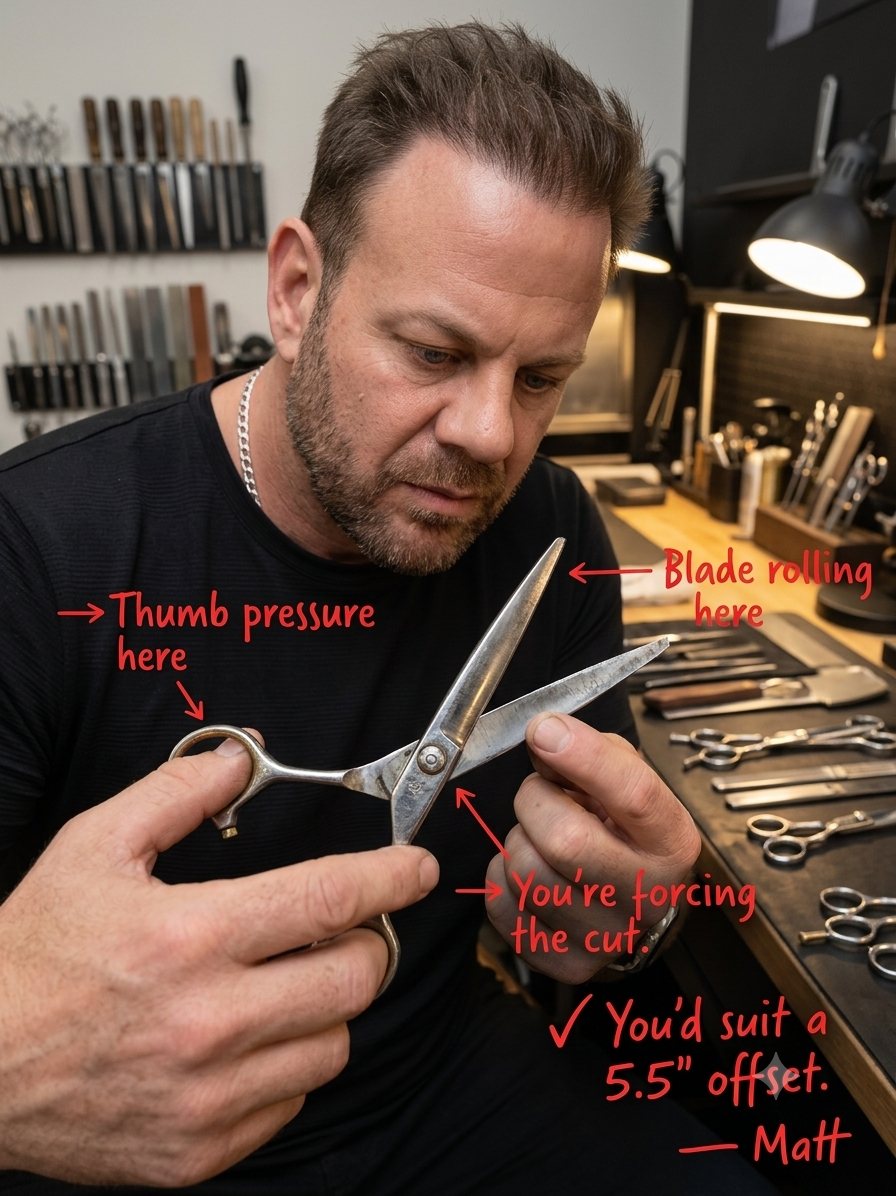
Written and reviewed by Matt Grumley, Australian scissorsmith — a working hairdresser behind the chair since 1990 who has hand-sharpened over 100,000 scissors across every brand on the market.
Spend enough to get a genuine professional tool, then stop paying for claims the seller cannot prove. In Australia, about $250–$400 is a realistic first-professional band and $380–$600 is where many primary full-time working scissors sit. Higher prices can buy meaningful refinement, but the number on the tag is never evidence by itself.
What the price bands should mean
Below about $150: training, occasional use or a backup
At this price the risk is not that every scissor is unusable; it is that the listing often gives you no way to verify the steel, heat treatment or edge. For full-time salon work, an unnamed “Japanese steel” claim is not enough. If there is no grade and no hardness, price is the only concrete specification — and price cannot tell you whether the edge will hold.
$250–$400: the first-professional band
This is where an apprentice or newly qualified stylist should expect named material, published hardness, a properly formed edge and a tension system that can be serviced. Decorative finish is optional. A real specification is not. The aim is a scissor that teaches clean technique instead of making the user squeeze harder to compensate for soft steel or poor blade contact.
$380–$600: the primary working band
A full-time main scissor commonly sits here. The extra value should be visible in the material, balance, finishing, pivot and serviceability — not a longer adjective list. This band overlaps the first-professional band because price tiers are not a ranking ladder: a well-specified $380 tool can be the correct lifetime workhorse, while a more expensive scissor can still be wrong for the hand or the job.
$600–$800: refinement or specialist work
Here you should be able to identify exactly what the extra money buys: a harder named alloy, more exact finishing, a lighter or more refined pivot, specialist blade geometry, or a design made for a particular cutting method. If the seller cannot name the difference, the price is doing the marketing work.
Above $800: verify every premium
High prices may reflect rare materials, hand work or specialist geometry. They may also reflect branding and distribution margins. Ask the same questions you would at $300. A costly scissor with no named steel, no published hardness and no accountable finisher is still an unverified scissor.
The five checks that matter more than price
- Exact steel grade: a named alloy, not “premium Japanese steel.”
- Published hardness: the professional working band is roughly 56–62 HRC, depending on the alloy and heat treatment.
- Edge geometry: a genuine convex edge for professional slicing work, finished correctly.
- Fit for the work: size, handle and blade shape matched to how the stylist actually cuts.
- Accountability: a named person or maker who finishes, inspects and can service the tool.
Calculate cost over the working life, not at checkout
The useful comparison is purchase price plus professional servicing plus premature replacement. A cheaper scissor that repeatedly loses its set can cost more than a sound tool kept in service for years. The reverse also matters: if your current scissor fits, holds tension and simply needs its edge restored, sharpening may be better value than buying again. As one transparent Australian example, ShearGenius publishes on-road sharpening at $70 per pair for its own scissors and $80 for other brands across Victoria and Tasmania, plus Mount Gambier and Millicent. That is a supplier’s published price, not a claimed national average.
See the technical checks in the scissor-selection guide, compare materials in the steel database, or read the current maker example at ShearGenius’s sharpening-service page.
Common questions
How much should a hairdresser spend on professional scissors?
For a first professional pair, about $250–$400 is a realistic Australian starting band. A primary full-time working scissor commonly sits around $380–$600. The right amount depends on the named steel, fit, edge geometry and the work the scissor must do — price alone is not proof of quality.
Are expensive hairdressing scissors always better?
No. Above the working band, extra cost may buy harder steel, a more refined pivot, lighter finishing or specialist geometry, but a high price does not prove any of those things. Ask for the exact steel grade, published Rockwell hardness and who finishes and services the scissor.
Should an apprentice buy cheap scissors first?
An apprentice needs a genuine professional tool, not necessarily a premium one. A named steel grade, published hardness, true cutting geometry and reliable tension matter more than decorative finish. Buying too soft a scissor teaches compensation for a tool that folds hair.
When should I sharpen my current scissors instead of replacing them?
If the scissor fits your hand, holds tension and has sound steel but has started folding or pushing hair, professional sharpening is usually the honest first step. Replace it when the steel repeatedly loses its set, the ride line or blade is damaged beyond sensible repair, or the size and handle do not suit the work.