Home / Thinning, texturising & channelling
Thinning vs Texturising vs Channelling Scissors
Three names, sold interchangeably, applied inconsistently by nearly everyone who makes them. The words will not tell you what a scissor does. The tooth count will.
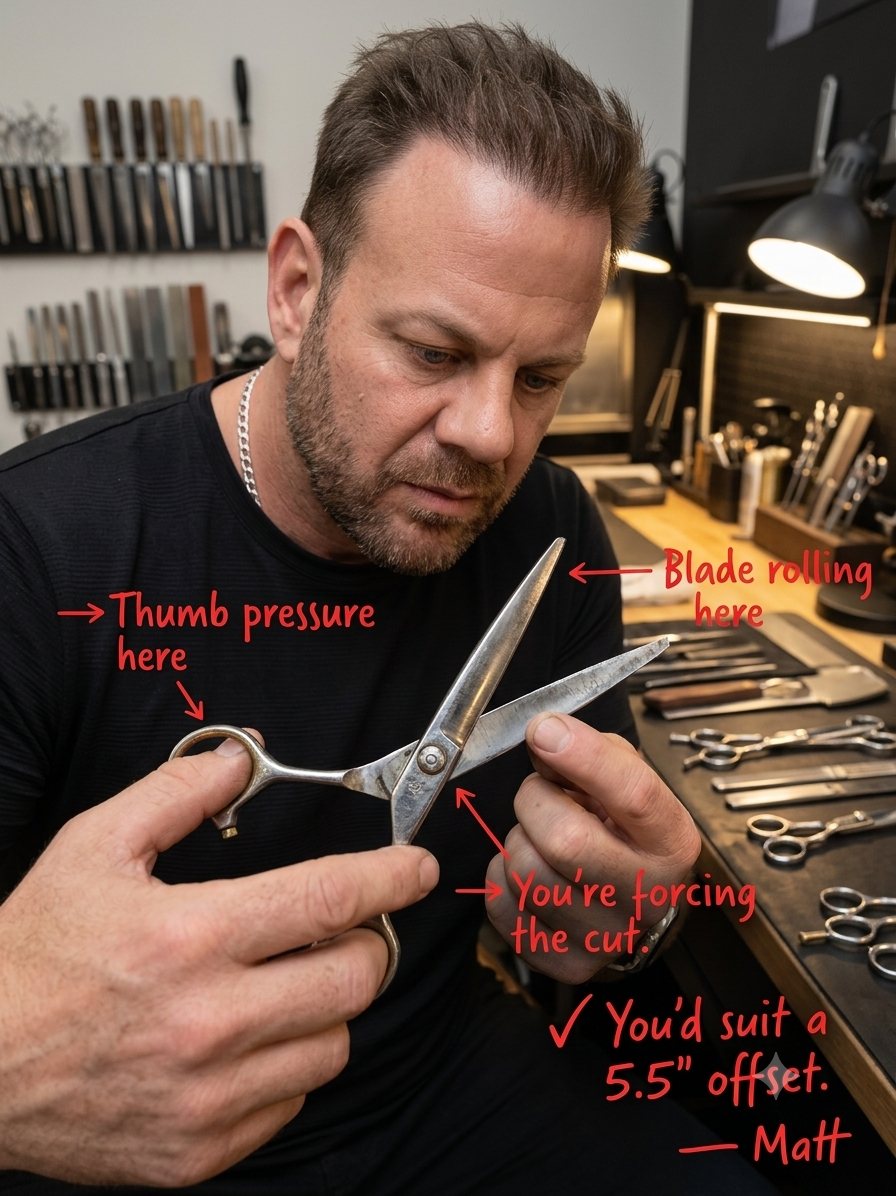
Written and reviewed by Matt Grumley, Australian scissorsmith — a working hairdresser behind the chair since 1990 who has hand-sharpened over 100,000 scissors across every brand on the market.
What the toothed blade is actually doing
A thinning scissor has one toothed blade and one straight one. When you close it, only the hair sitting between the teeth gets cut — everything sitting in the gaps passes through untouched. That is the whole mechanism, and everything else follows from it.
So two numbers decide the result: how many teeth there are, and how wide the gaps between them are. The name printed on the box decides nothing.
Reading the tooth count
- Around 30 to 40 teeth — fine blending. Narrow gaps, a little hair removed very evenly. This is work the client should never be able to see: softening a line, feathering a graduation, blending a colour change. On fine or coloured hair this is usually the only appropriate density.
- Around 25 to 30 teeth — everyday texturising. The general-purpose density. Enough removal to take weight out of medium-density hair in a pass or two, still even enough to stay invisible if you keep it away from the root.
- Roughly 7 to 15 wide teeth — channelling or chunking. Not a blending tool at all. It carves channels through the section to create deliberate separation, movement and a lived-in finish. The result is meant to be visible.
The pattern is counter-intuitive at first: more teeth means less visible removal, not more. A high-tooth blade takes a small amount from everywhere; a low-tooth blade takes larger amounts from fewer places, which is exactly why it shows.
“Most of the ‘my thinners left holes’ jobs I see aren’t bad technique. It’s a chunker being used where a blender was needed.”
Matching the tool to the job
- Softening a blunt line — high tooth count, tips only, well away from the root.
- Removing weight from thick hair — mid tooth count, mid-length, working in layers rather than one heavy pass.
- Blending a graduation or a colour change — high tooth count. This is invisible work.
- Creating movement and separation — channeller. This is visible work, and it should be.
- Fine or chemically treated hair — high tooth count only. A coarse blade removes too much for the density and the ends fray.
The three faults that get blamed on the scissor
- Working too close to the root. Short ends grow out standing up. Keep removal to the middle and ends of the section.
- Too coarse for the hair type. A chunker on fine hair leaves gaps you cannot cut back in.
- A blunt toothed blade. Teeth go blunt like any edge. A blunt one pushes and bends hair instead of cutting it, which reads as damage but is a sharpening problem — see when to sharpen. Thinners need servicing on the same cycle as your cutting scissor, and most people forget them entirely.
How many do you actually need?
Most stylists need one, matched to the hair they see most: a high-tooth blender if you work fine or coloured hair, a mid-count texturiser if your chair is mixed. A channeller is a third tool bought for a specific look, not a starting point.
Buy it in the same steel and hardness you would demand of a cutting scissor — a toothed blade run soft goes blunt just as fast and is harder to notice. The steel database lists what each grade should reach.
If you want to see the densities side by side, ShearGenius makes the full spread — a 35-tooth for invisible feathering, 26- and 30-tooth everyday texturisers, and a channeller with a low count of wide teeth for deliberate separation — and pairs each one to a matching cutting scissor, which matters more than it sounds: a thinner that does not match the weight and balance of the scissor in your other hand never quite feels right. If you are unsure which density suits the hair you actually see, a fitting is free.
Common questions
What is the difference between thinning and texturising scissors?
In practice the two words describe the same tool used with different intent, and makers apply them inconsistently. What changes the result is the tooth count and the gap width.
What does the tooth count on thinning scissors mean?
The toothed blade only cuts hair sitting between the teeth. More teeth means narrower gaps and a finer, more even removal; fewer, wider teeth remove hair in visible sections.
What is a channelling scissor?
A channelling or chunking scissor has very few wide teeth. It is not a blending tool — it carves channels to create deliberate separation and movement. Used where a blender was needed, it leaves visible holes.
Do thinning scissors damage hair?
The tool does not, but the technique can — working too close to the root, or using a coarse blade on fine hair. A blunt toothed blade also bends hair rather than cutting it, which is a sharpening problem.