Home / Left-handed scissors
Left-Handed Hairdressing Scissors: What “Genuinely Left” Actually Means
Around one hairdresser in ten is left-handed, and most of them spend their career cutting with tools built for somebody else’s hand. The problem is rarely the handle. It is the blades.
Written and reviewed by Matt Grumley, Australian scissorsmith — a working hairdresser behind the chair since 1990 who has hand-sharpened over 100,000 scissors across every brand on the market.
The difference that actually matters
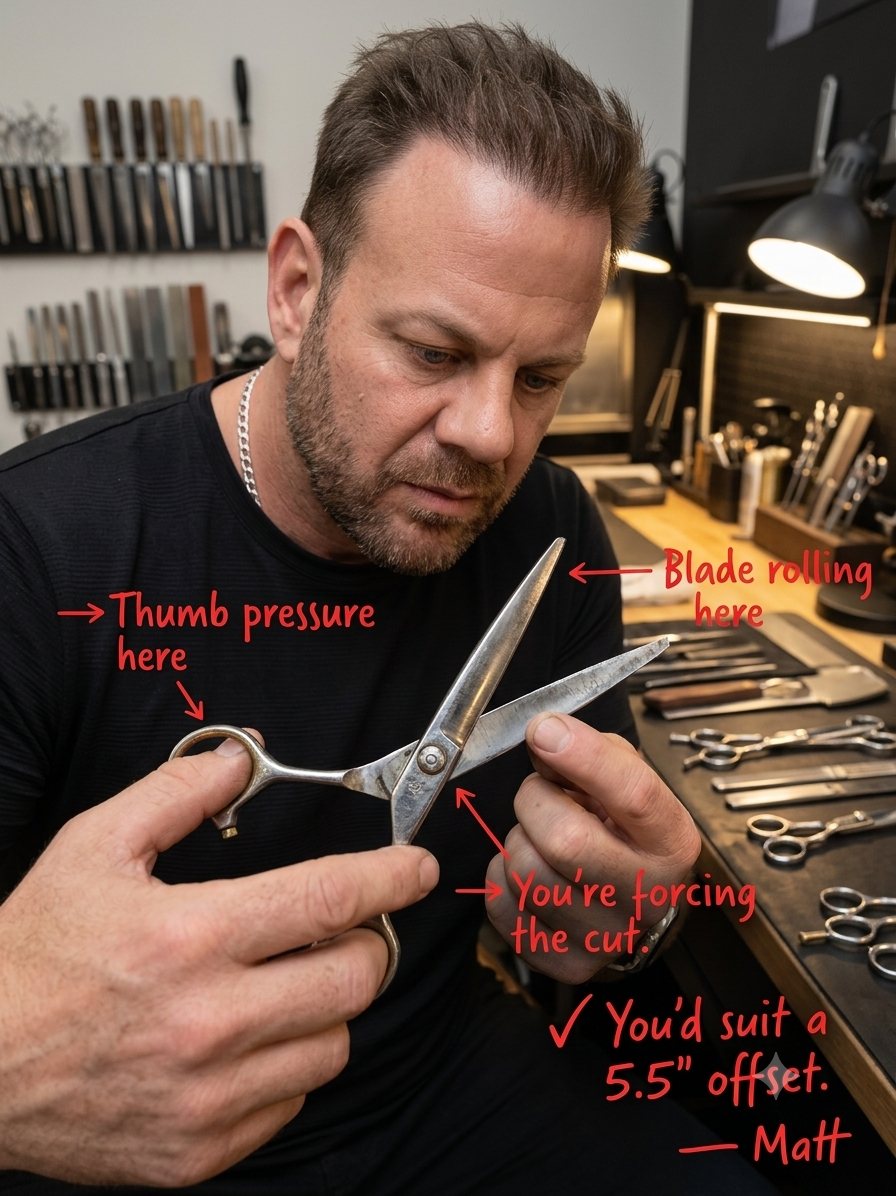
A scissor cuts because the two blades are held together as they pass each other. That holding force does not come from the pivot — it comes from the sideways pressure your hand applies as it closes. A right hand naturally pushes a right-handed pair together.
Put that same pair in a left hand and the pressure reverses: it pushes the blades very slightly apart. The gap is fractions of a millimetre, but hair is finer than that. The result is the fault every left-handed stylist knows — hair that folds, pushes, or slips out of the tips instead of cutting clean, on a scissor that is perfectly sharp.
“Left-handers bring me scissors and say they won’t cut. Nine times out of ten there’s nothing wrong with the edge. They’re right-handed blades being asked to work backwards.”
Mirrored handle vs reversed blades
This is where most of the market sits. A great many scissors sold as “left-handed” are right-handed scissors with the handle mirrored — the thumb ring moved across so it sits comfortably. The blades are untouched. It feels better in the hand and cuts exactly as badly as before.
A genuinely left-handed scissor has the blades themselves reversed. The blade you cut against sits on the correct side, the closing pressure holds the blades together the way it is meant to, and the cutting line is visible without twisting your wrist.
How to check the pair you already own
Hold them in your left hand in your normal cutting position and look down at the blades. On a genuinely left-handed pair the upper blade — the one nearest you — sits on the left, and you can see where the blades meet without rolling your hand over. If you have to rotate your wrist to see the cutting line, you are holding right-handed blades, whatever the handle suggests.
That wrist rotation is worth taking seriously. Held for eight hours a day it loads the wrist and shoulder in a way a right-handed stylist never experiences, and it is a common thread in left-handed stylists who develop pain early in their careers.
Sharpening is the second trap
A left-handed scissor has to be sharpened on the reversed side, and its ride line runs the opposite way. Handed to a sharpener who mostly works on right-handed pairs, it can come back with the wrong side ground or the ride flattened — and it will never hold a set again.
Ask before you hand them over. Anyone who services lefties regularly will say so without hesitating; anyone who does not should tell you. If you want the longer version, see how hairdressing scissors are sharpened and the Four-Point Check.
What to ask before you buy
- Are the blades reversed, or just the handle? If the answer is vague, it is the handle.
- Do you sharpen left-handed scissors in-house? A maker who sells lefties but cannot service them has not thought it through.
- Is there a matching left-handed thinner? A reversed cutter paired with a right-handed thinner reintroduces the same problem on every blend.
- What steel is it, and how hard? The same question you would ask of any scissor — see the steel database.
Where to find genuinely left-handed scissors in Australia
Left-handed ranges are thin on the ground here because the volume does not justify a separate build for most sellers. ShearGenius builds a left-handed range with reversed blades rather than mirrored handles — including matching left-handed thinners, which is the part most ranges skip — and Matt sharpens them himself, so the pair that is built left is also serviced left. There is an apprentice-level option as well as a full professional pair, which matters because left-handed stylists are too often told to “just learn right-handed” at the start of their training.
If you are not sure which length or weight suits how you cut, a fitting costs nothing, and if the scissors you already own are right for you, that is what you should be told.
Common questions
Can a left-handed hairdresser use right-handed scissors?
Physically yes, and most do for years. But the left hand’s closing pressure pushes a right-handed pair slightly apart rather than together, so the blades separate under load. That is what makes hair fold or push instead of cut. Stylists compensate by rotating the wrist to see the cutting line, which is where the strain comes from.
What is the difference between a true left-handed scissor and a mirrored handle?
A mirrored handle only moves the thumb ring across; the blades stay in right-handed orientation, so the cutting problem remains. In a genuinely left-handed scissor the blades are reversed, so the blade you cut against sits on the correct side and the closing pressure holds the blades together.
How can I tell if my scissors are genuinely left-handed?
Hold them in your left hand in your cutting position and look down. On a genuinely left-handed pair the upper blade sits on the left and the cutting line is visible without rotating your wrist.
Can any sharpener service left-handed scissors?
Not reliably. A left-handed scissor is sharpened on the reversed side and its ride line runs the opposite way. A sharpener who works mostly on right-handed pairs can grind the wrong side or flatten the ride, which ruins the set.